How to Become a PADI Scuba Diving Instructor
25 May 2026
How to Become a PADI Scuba Diving Instructor (2026 Guide)
A PADI scuba diving instructor qualification is one of the most globally portable certifications in the watersports industry. Certified PADI instructors work at dive centres, liveaboards, and resorts from the Great Barrier Reef to the Red Sea, the Maldives to the Caribbean — and the structured PADI pathway from beginner diver to qualified instructor is one of the clearest progression routes in any water-based career.
This guide walks through every step of the process, from your first Open Water course to passing the PADI Instructor Examination and beyond.
What Does a PADI Scuba Diving Instructor Do?
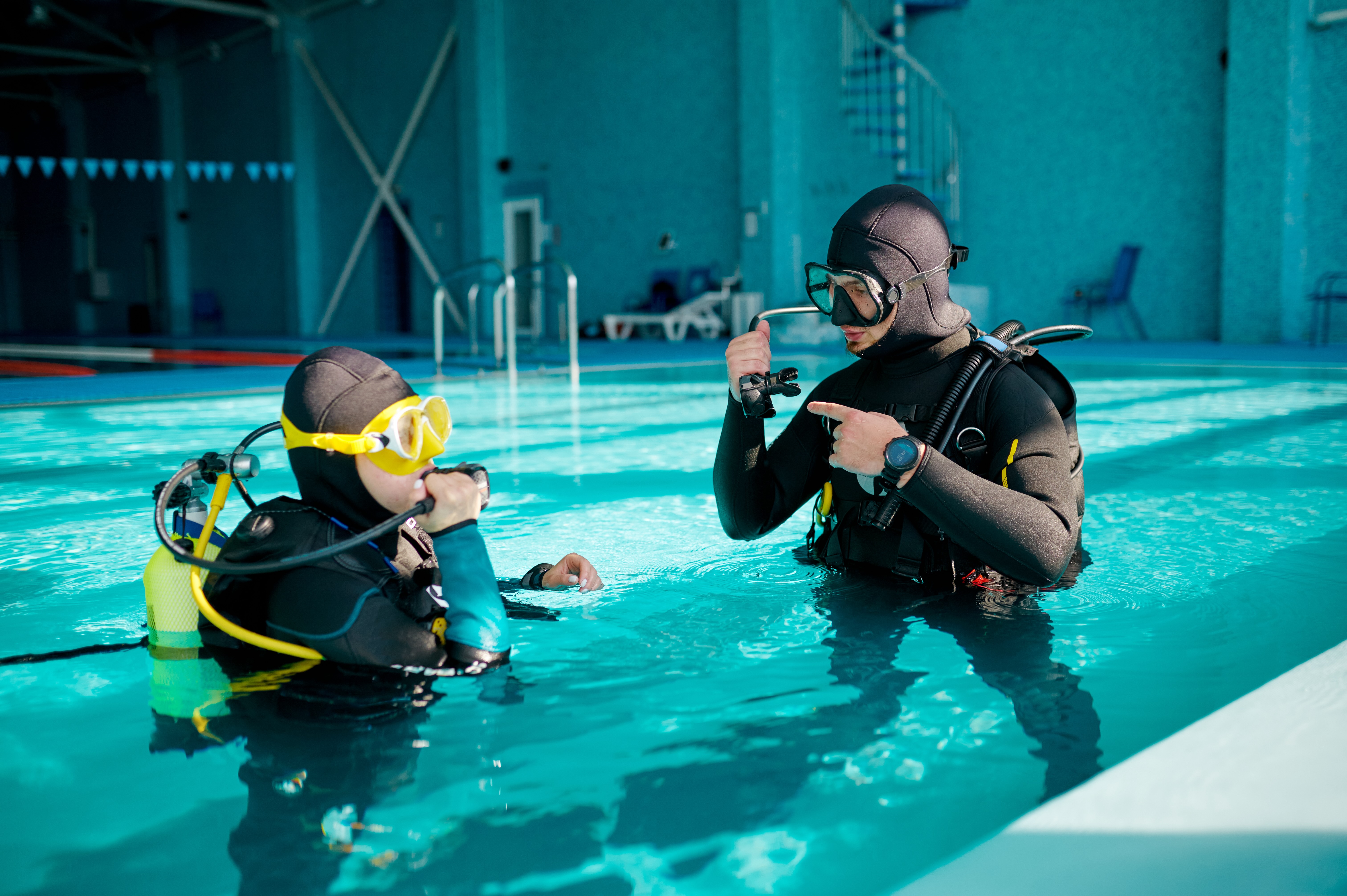
PADI instructors teach recreational scuba diving — from introductory Discover Scuba experiences and Open Water certifications through to Advanced Open Water, Rescue Diver, Divemaster, and specialty courses. Depending on your experience level and employer, you might be running pool sessions at a dive school, leading open water training dives on a coral reef, or mentoring Divemaster candidates at a busy liveaboard operation.
The role combines deep technical knowledge with teaching ability, strong safety management, and genuine comfort in a range of underwater environments. It is one of the few watersports instructor roles that requires a substantial personal certification journey before instructor training even begins.
The PADI Pathway at a Glance
Unlike most watersports instructor routes, becoming a PADI instructor requires progressing through multiple certification levels as a diver before you can enter instructor training. The full pathway looks like this:
Open Water Diver → Advanced Open Water Diver → Rescue Diver → Divemaster → IDC → Instructor Examination → OWSI
Each stage builds on the last. There are no shortcuts — and for good reason. By the time you reach instructor level, you'll have accumulated significant real-world diving experience across a range of environments and conditions.
Step 1: Get Your Open Water Diver Certification
The PADI Open Water Diver course is the entry point for the entire pathway. It covers the fundamentals of scuba diving: equipment, dive physics, underwater communication, buoyancy control, and basic safety procedures. You'll complete pool or confined water sessions followed by four open water training dives.
What it covers:
Dive equipment setup and function
Underwater communication and signals
Buoyancy control and equalisation
Emergency procedures and basic rescue skills
Most Open Water courses take 3–4 days to complete. They're available at PADI-affiliated dive centres worldwide.
Step 2: Complete Your Advanced Open Water Diver Course
The Advanced Open Water Diver (AOWD) course develops your diving across a range of speciality environments. It consists of five adventure dives, two of which — deep diving and underwater navigation — are mandatory. The remaining three can be chosen from a wide range of options including night diving, wreck diving, drift diving, and peak performance buoyancy.
This course is not an advanced test of existing skills — it's a structured introduction to new diving environments that broadens your experience and builds confidence across conditions you'll eventually be teaching in.
Step 3: Complete Rescue Diver and Emergency First Response (EFR)
The Rescue Diver certification is widely regarded as the most important course in the recreational diving pathway — and is mandatory before Divemaster training. It shifts the focus from personal diving to managing others, covering stress recognition, diver rescue techniques, emergency management, and post-rescue care.
Alongside Rescue Diver, you must complete an Emergency First Response (EFR) certification covering CPR and first aid. The PADI EFR course meets this requirement, as do many equivalent first aid qualifications.
After Rescue Diver you should have:
A minimum of 40 logged dives (required to start Divemaster)
Valid EFR / CPR certification
Genuine comfort in open water across varied conditions
Step 4: Become a PADI Divemaster
The PADI Divemaster certification is the first professional level in the PADI system — and the most significant step change in the entire pathway. As a Divemaster, you shift from recreational diver to dive professional: leading dive activities, assisting instructors during courses, supervising certified divers, and beginning to take on real responsibility for others underwater.
Entry requirements for Divemaster:
Minimum age: 18
Certified Rescue Diver
Current EFR certification
Minimum 40 logged dives to start; 60 dives to complete the course
What Divemaster training covers:
Dive theory: physics, physiology, decompression theory, equipment, and the diving environment
Dive leadership skills and dive briefing techniques
Assisting instructors during Open Water and Advanced courses
Conducting guided dives and supervising certified divers
Problem solving and stress management underwater
PADI standards and the professional diving framework
Divemaster training is typically completed over 2–8 weeks depending on your availability and the pace of the programme. Many aspiring instructors use this period to log significant additional dives and build open water experience in varied environments.
Step 5: Enrol in the Instructor Development Course (IDC)
The IDC is the core instructor training programme and the final preparation before the PADI Instructor Examination. It is divided into two parts:
Assistant Instructor (AI) Programme
The first part of the IDC covers foundational instructor-level skills: how to conduct classroom presentations, run confined water sessions, and manage student safety during training dives. Completing the AI programme allows you to teach certain introductory programmes while continuing toward full OWSI status.
Open Water Scuba Instructor (OWSI) Programme
The second part focuses on the full range of PADI courses — how to teach Open Water, Advanced, Rescue, and Divemaster programmes — and prepares you comprehensively for the Instructor Examination.
IDC content covers:
Dive theory at instructor level: physics, physiology, decompression, equipment, and environment
Teaching confined water (pool) skills and managing training dives
Classroom presentation and learning theory
PADI system standards, course requirements, and paperwork
Safety management, problem prevention, and emergency procedures
Teaching demonstrations and peer feedback
IDC programmes typically run 7–10 days and are delivered by a PADI Course Director at a PADI-affiliated training facility. The quality and experience of your Course Director matters significantly — choose carefully.
Step 6: Pass the PADI Instructor Examination (IE)
The IE is a standardised two-day examination conducted by independent PADI Examiners — not by your Course Director, which ensures objectivity. It is the final qualifying assessment for OWSI status.
IE components:
Written exams on dive theory and PADI standards
Teaching demonstration in a confined water (pool) setting
Teaching demonstration in an open water setting
Classroom presentation
Rescue scenario and skill demonstration
IE entry requirements:
Minimum age: 18
Current PADI Divemaster certification
Completed IDC
Minimum 100 logged dives
Current EFR certification
Pass rates vary by preparation quality. Candidates who complete a thorough IDC with an experienced Course Director and arrive with well over 100 logged dives across diverse environments consistently perform better.
Step 7: Begin Teaching as a PADI OWSI
On passing the IE, you become a certified PADI Open Water Scuba Instructor — qualified to teach the full range of PADI recreational courses from Discover Scuba through to Divemaster.
First teaching roles typically involve:
Discover Scuba Diving (DSD) introductory experiences
Open Water Diver courses
Advanced Open Water Diver courses
Assisting with Rescue Diver and specialty courses
Start by building a strong foundation teaching beginner courses before progressing to more complex programmes. Your log of certified students is a professional record that matters — quality instruction builds a reputation that travels in the diving industry.
Browse scuba diving instructor jobs on BoatyJobs →
Step 8: Advance to Master Scuba Diver Trainer (MSDT)
Once you have certified at least 25 divers as an OWSI and taught five or more PADI Specialty courses, you qualify to apply for Master Scuba Diver Trainer (MSDT) status. This is a significant career milestone that expands your teaching scope and professional credibility.
MSDT instructors can teach a broader portfolio of courses, mentor Divemaster candidates more formally, and are often preferred for senior roles at established dive operations.
Step 9: Maintain Your PADI Membership and Continue Developing
PADI instructor status requires annual membership renewal and ongoing professional development. Letting your membership lapse means you cannot legally teach PADI courses — keep this current without exception.
Ongoing requirements:
Annual PADI membership renewal
Current EFR / CPR certification (renew every 24 months)
Participation in continuing education: PADI seminars, new course updates, and specialty training
Stay current with equipment developments, particularly dive computer technology and drysuit systems
How Long Does It Take to Become a PADI Instructor?
The PADI pathway is longer than most watersports instructor routes — and deliberately so.
Stage Approximate time Open Water → Rescue Diver 3–6 months minimum Divemaster training 2–8 weeks Building dive experience (to 100+ dives) 6–18 months IDC 7–10 days IE 2 days Total from beginner 12 months minimum; 2–3 years realistic
Many instructors spend 2–3 years on the pathway while travelling and diving in varied locations — building experience, logging dives, and completing courses along the way. Attempting to rush the process by logging minimum dives in a single location produces weaker instructors and reduces IE pass rates.
How Much Do PADI Scuba Diving Instructors Earn?
Scuba diving instruction is one of the few watersports careers with genuinely global salary comparability — PADI rates are recognised worldwide and experienced instructors can move between markets fluidly.
Entry-level OWSI (resort / dive school): $1,500–$2,500/month + accommodation and diving
Experienced OWSI (established dive centre): $2,500–$4,000/month
Liveaboard instructor: $2,000–$4,500/month (highly variable by vessel and route)
MSDT / Course Director: $4,000–$7,000+/month at premium operations
Freelance / private instruction: $50–$150+/hour depending on location
Instructors who progress to Course Director level — the qualification that allows you to run IDC programmes — access the highest earning tier in recreational scuba instruction.
Frequently Asked Questions
How much does it cost to become a PADI instructor? Budget $3,000–$6,000+ for the full pathway from Open Water to OWSI, not including travel, accommodation, and dive equipment. The IDC alone typically costs $1,000–$2,500 depending on location and Course Director. Completing parts of the pathway in lower-cost destinations (Southeast Asia, Egypt, Central America) can significantly reduce overall costs.
Where is the best place to do PADI instructor training? Popular IDC locations include Koh Tao (Thailand), Hurghada and Dahab (Egypt), Gili Islands (Indonesia), the Philippines, and the Canary Islands. These locations combine affordable training costs with excellent diving conditions for logging the required dives. The quality of the Course Director matters as much as the location.
Can I teach other brands' courses as a PADI instructor? PADI certification specifically qualifies you to teach within the PADI system. SSI, NAUI, and other agencies have their own instructor pathways. Many dive centres are affiliated with a single agency; some accept crossover qualifications. If you want to work across multiple agencies, you'll need to cross-certify through the relevant instructor programme.
Is PADI the best scuba instructor certification? PADI is the largest recreational scuba training organisation in the world and the most widely recognised certification for employment at dive resorts, liveaboards, and schools globally. SSI (Scuba Schools International) is the second most recognised and is accepted at many of the same facilities. For maximum global job market access, PADI is the standard choice.
Do I need my own dive equipment to become an instructor? You'll need your own basic equipment — mask, fins, wetsuit or drysuit, and preferably your own regulator and BCD — for both Divemaster training and the IDC. Many training centres can provide equipment rental, but owning your own gear is expected at professional level and required by many employers.
Ready to Find a Scuba Diving Instructor Job?
BoatyJobs lists scuba diving instructor vacancies worldwide — from entry-level OWSI positions at resort dive schools to senior MSDT and Course Director roles at established liveaboard and dive resort operations.